

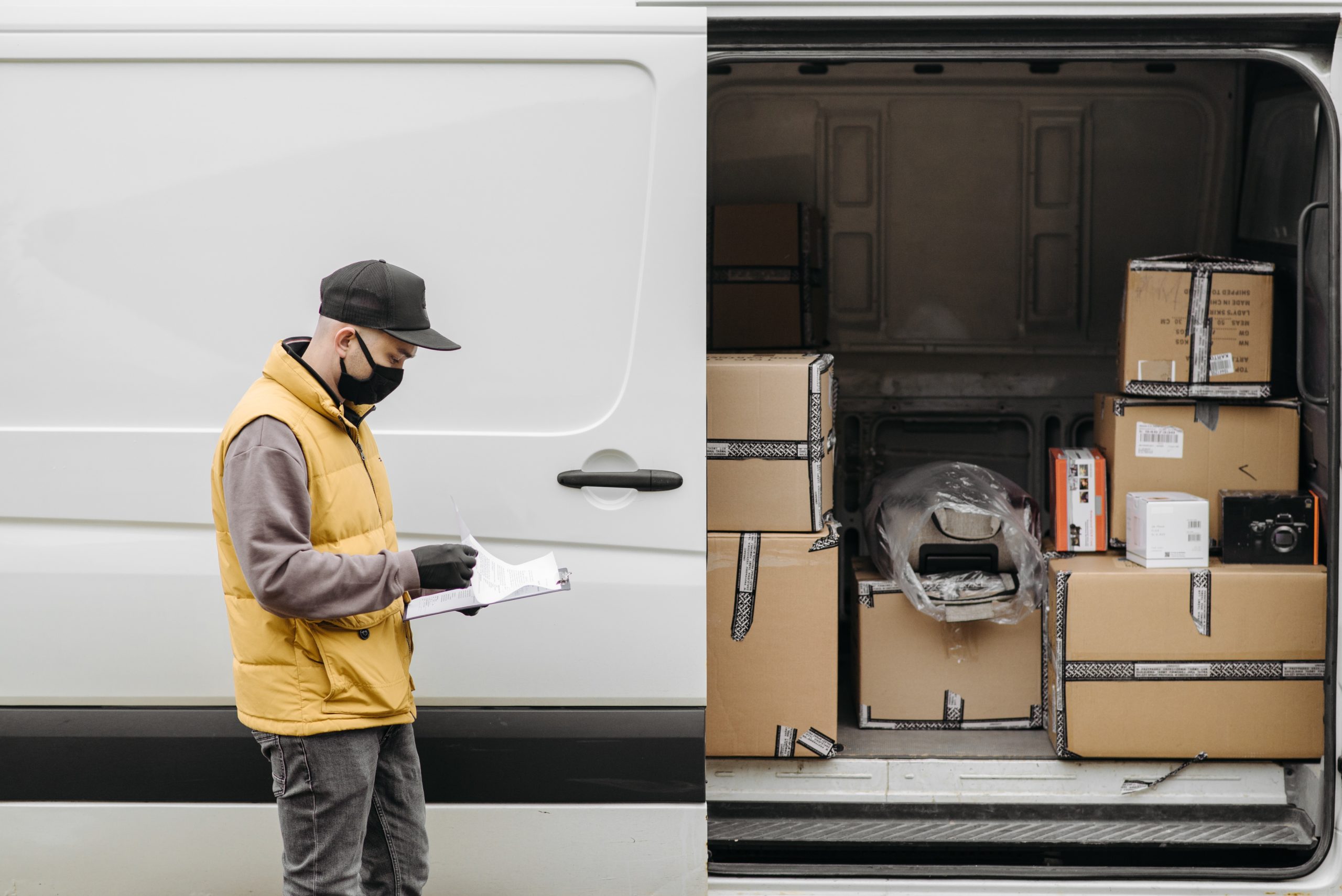
As consumers begin to implement technology into every aspect of their lives, quick fulfillment and distribution isn’t a commodity; it’s a necessity. Businesses that are looking to gain market share and go up against the giant, Amazon, need to develop new technologies to expedite delivery and promote a positive customer experience.
By the end of this article, you will be aware of the main concepts of this revolutionary industry and some of the technology-related solutions that are helping businesses tackle product distribution. .If you have a business that is related to or dependent on last-mile delivery, this article will be extremely helpful if you are looking to upgrade or expand your delivery methods. .

El Corte Ingles Smart Locker powered by Bloq.it, located in Lisbon – Portugal (Photo by El Corte Ingles)
What is the Last-Mile Delivery?
The most generic definition we can give to the what is the last-mile delivery question is the one associated with supply chain and logistics-related scenarios.
The last-mile delivery refers to the final step or final destination process of a product – whether it is from the warehouse, fulfillment center, or store to the final consumer’s desired drop-off address.
Although the concept is very straightforward, the logistics behind any product transfer from point A to the final destination is very complex, turning the last-mile delivery into the most expensive part of any fulfillment chain.
To understand what is last-mile delivery, let’s rewind to how the logistics involved in last-mile delivery were before e-commerce came to place. This will help us understand the challenges most businesses are facing these days.

Before the digital era, the last-mile transfer of products was expected to go from the manufacturers or warehouses to retail stores or other types of business.
The operations were more straightforward and deliveries were done in bulks keeping costs considerably.
Once the e-commerce wave hit us all, the scenario changed completely. We are back to questioning ourselves again: what is the last-mile delivery?
Innovation can change an entire society. The dynamics and technologies that were once unthought of are now involved in every aspect of daily life. Take cell phones for instance. Individuals and businesses couldn’t think of a society based on a device. However, 10 years later, almost everyone has a cellphone. Receiving parcels and package deliveries are facing similar changes.
Before going deeper into these new technologies, let’s cover the problem.

The Current Last-Mile Delivery Problem
To complement our understanding of explaining the last-mile delivery, we need to point out some of the inconveniences we can easily find.
We have firsthand insight into last-mile expert claims that are affecting businesses in most industries.
However, if we had to sum them up into one central problem, we could say that the main challenge is the increasing demand customers impose in hopes for more instant delivery.
The first last-mile delivery problem we want to highlight is cost.
Last-mile deliveries in the e-commerce era involve single items dropped door to door, resulting in multiple stops. On the contrary, bulk delivery leads to congestion in urban areas and driving miles apart in rural areas.
The unnecessary resources in terms of labor and fuel (e.g., diesel) indicate that the door-to-door delivery represents substantial and avoidable monetary losses for businesses.
Customers expecting more control and faster deliveries is the central and critical challenge for the last-mile industry. According to studies, instant delivery is expected to grow at a compound annual growth rate (CAGR) of 20.3% from 2020 to 2027.
This growing demand doesn’t just indicate rising costs but also traffic congestion and more pollution in both urban and rural areas. Door-to-door delivery and a more instant delivery demanded by customers limit the opportunity for courier companies to make the most out of their routes by optimizing and upgrading their methods.
The good news is that challenges always leave room for innovation, and to sum up this article we will list below some of the solutions technology can offer in this extremely dynamic and volatile industry.

Innovative Solutions Taking on Last-mile Challenges
Having a clear understanding of what is the last-mile delivery and the challenges within the industry would be pointless if we didn’t address the following question:
How can technology optimize last-mile delivery operations to meet customers’ demands while avoiding delayed deliveries to comply with people’s high expectancy for fast delivery while keeping costs at a low?
Plenty of futuristic last-mile delivery trends indicate that Micro Fulfillment and Smart Lockers seem to be the most immediate solution for a variety of businesses, consequently driving a more automated delivery process in most urban areas.
Implementing Micro Fullfillment Solution
A new strategy most retailers are implementing is using stores and retail backrooms to fulfill quick-commerce demands.
According to studies, over 47% of consumers won’t recommend a retailer if they can’t get same-day delivery of products.
In this competitive era, businesses can’t afford to lose customer loyalty. Therefore, using storefronts and shopping malls is one of the best strategies to facilitate quick deliveries.
For retailers that are not located near their customers’ bases, parcel lockers seem to be the correct answer to solve the last-mile problem.
Smart Locker Solution
Some businesses cannot count on a location-based strategy of having their stores close to their customers.
Instead, they might need to ship products directly from warehouses.
If this is the case, self-service lockers help lower delivery times, failed first attempt deliveries, and even lowers costs by checking all the boxes to comply with their customers’ demands whilst keeping costs within profit margins.
In fact, studies carried out by the University of Washington Supply Chain Transportation and Logistics Center have shown that Smart Locker delivery reduces the total delivery time by 78% compared to traditional delivery methods.

How Can Bloq.it Smart Lockers Help Your Business?
At Bloq.it, we are at the forefront of locker systems integration and development for various industries, including last-mile deliveries.
We strive to develop the most innovative application interface that adapts to your existing workflow, letting you gain complete power over the service interface with 100% adaptability.
Our Smart Lockers, powered by Bloq.it technology, are already present in more than 10 countries around the world.
If you are still confused on what is a the last-mile delivery, let’s discuss more on how our technology can help your business optimize delivery operations.
Reach out to one of our experts and let’s find the best solution for your business, together.